
Kerala, Karnataka, Tamil Nadu and Telangana have announced a lockdown of educational institutions, malls and other places that attract people in large numbers, even as some of them have been reporting increase in positive cases.
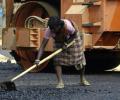
Modi placed a $12.6 billion bet in this year's budget on road building

Available evidence suggests that we are on the way to a very costly failure of the current demonetisation scheme, says M R Narayana.

In a televised address to the nation, Singapore Prime Minister Lee said the government was committed to do its "utmost" to keep the deadly virus at bay.
Even if the same party returns to power, what is important to debate is that having introduced an entitlement, how challenging it is to reverse such decisions, says Mukesh Butani.
Grand plan: 10% GDP growth; 175 million jobs; $10-trillion economy
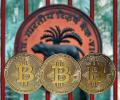
'India should start leveraging rather than banning crypto.'

Private firms will have to maintain a minimum net addition to their workforce each month from October this year to June 2021 to get the Employees' Provident Fund subsidy for the new recruits.

'For around five hours the storm, reportedly the strongest one ever recorded in the Bay of Bengal, that mother of many a deathly vortex, shook Kolkata like a toddler playing with a rattling toy,' observes Debashish Chatterjee.
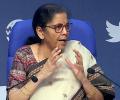
'The Modi government is about privatising profits and nationalising losses.'

The United States leads the world with more than 1.6 million confirmed coronavirus cases, according to a tally by Johns Hopkins University.

Is the XUV700 just a facelifted XUV500 or is it a completely new breed in the vast range of SUVs available today? Rajesh Karkera takes the latest offering from the Mahindra stable for a spin to find out.

India is currently under the 21-day lockdown since March 25, with only essential services exempted to contain the fast-spreading virus.

Even after five decades of use, the telescope at Ooty that Dr Govind Swarup designed and built continues to be the largest single frequency radio telescope in the world.
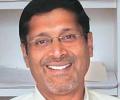
Noted economist Arvind Subramanian is favoured as the choice for the government's Chief Economic Advisor (CEA).
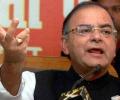
Finance Minister Arun Jaitley has said that the states were free to announce farm loan waivers if they had the fiscal space and that there would be no shortfall this year in divestment and non-tax revenues.

Snooping is one of the oldest peccadilloes of man, observes Ambassador M K Bhadrakumar.

'We are having an outsize impact not only on the lives of the customers and livelihood, but also the economy of India.'

Businessman P C Mustafa wants Indian Americans to return home, Cognizant CEO Francisco D'Souza outlines how Indian tech companies could grow, Gaurav Dalmia has some investment recommendations while Subramanian Swamy warns that India is flirting with a debt trap.

Indians at large harbour a notion that their country is cherrypicking out of the American basket of goodies, but the policymakers in Delhi and the political leadership are well aware that it can only be a pipe dream since a military alliance with a superpower is a profound irrevocable commitment, observes Ambassador M K Bhadrakumar.

'If Indians are to be truly protected, Parliament must review and address these dangerous provisions before they become law.'

Prithviraj Hegde explains the first results of the demonetisation exercise in layman terms.
Prithviraj Hegde explains the first results of the demonetisation exercise in layman terms.
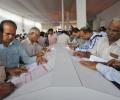
Questions on the efficacy of the government's drive towards filing of more returns by individuals and on whether raising tax exemption levels has led to reduced compliance in filing of returns by those who go out of the tax net, says A K Bhattacharya.

Traditionally, financial institutions have operated risk functions in silos. However, the nature of unknown threats today requires industry participants to work together, says Vikram Limaye.

'We are training people to learn AI, machine learning, robotics; it is just new programmes that teach them new things and the raw material, the people, are eager to learn.'
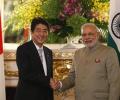
The commitment by Japan to invest $35 billion or 3.5 trillion YEN is for infrastructure sector over five years.

'Even after vaccines are given, precautions like using a mask and maintaining social distancing have to be taken.'

In a pre-budget meeting with Finance Minister Arun Jaitley, the experts suggested timely implementation of the BJP's election manifesto promises to fix higher support prices. They also favoured a Kissan TV channel, an efficient procurement policy, priority for farm mechanisation and the linking of rivers.

The government claims the existing safeguards under the law are adequate, lawful, towards a legitimate purpose and provide for a "proportionate interference" in citizens' right to privacy, reports Nitin Sethi.
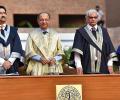
'What is forgotten but is actually as important for a society's long run success is morality.' 'Morals and trust are the nuts and bolts of an economy.' 'Without those you can get short run success, but not long-run development.'

'The variables to watch include the monsoon, resolution of NBFC liquidity issues, GST collections, and NPA resolution.'
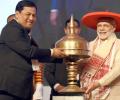
'The significance and timing of the PM's start of the campaign journey from Silchar is a clear message that the Barak valley is a priority in his scheme of things,' notes Subimal Bhattacharjee.
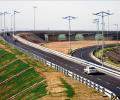
The markets regulator made it easier for banks to acquire control in listed companies.

'Let us also not expect that there will be a clean break with the past, much though the new government might like to think about it. In a functional democracy that is neither feasible nor desirable. But basic change it must be,' says Shreekant Sambrani.

Mr Modi must stop talking, and start writing

Over two dozen Muslims have been elected to the Lok Sabha. This shows that all is not lost for India's Muslims, suggests Mohammad Sajjad.
India must weave a quick-fix formula to ensure growth.

'We appreciate his positive evaluation of the relationship and share his optimism about its future directions.' 'We look forward to welcoming him in India next week for detailed discussions on further strengthening of our partnership,' the MEA said on Friday.
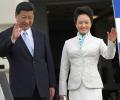
'India and China have to make concrete progress with regard to the border issue, addressing the trade deficit, and facilitating people-to-people interactions. This has to happen in the next two, three years.' China expert Tansen Sen tells Sheela Bhatt/Rediff.com how India and China can take their relations to the next level.
